What is AUSTRAC Tranche 2?
AUSTRAC Tranche 2 is the second phase of Australia's Anti-Money Laundering and Counter-Terrorism Financing (AML/CTF) reforms, commencing 1 July 2026. It brings approximately 80,000–90,000 professional services firms — including lawyers, accountants, conveyancers, real estate agents, and insolvency practitioners — into the AML/CTF regime for the first time. These entities must enrol with AUSTRAC, develop a compliant AML/CTF programme, and implement customer due diligence procedures. There is no grace period.
Which professional services firms must comply?
Tranche 2 applies to eight categories when providing a designated service: lawyers and law practices, accountants, conveyancers, real estate agents, dealers in precious metals and stones, trust and company service providers, insolvency practitioners, and financial advisers not already regulated under Tranche 1. The obligations attach immediately upon provision of a designated service from 1 July 2026 — not from when you first register with AUSTRAC.
What is an AML/CTF programme and is it mandatory?
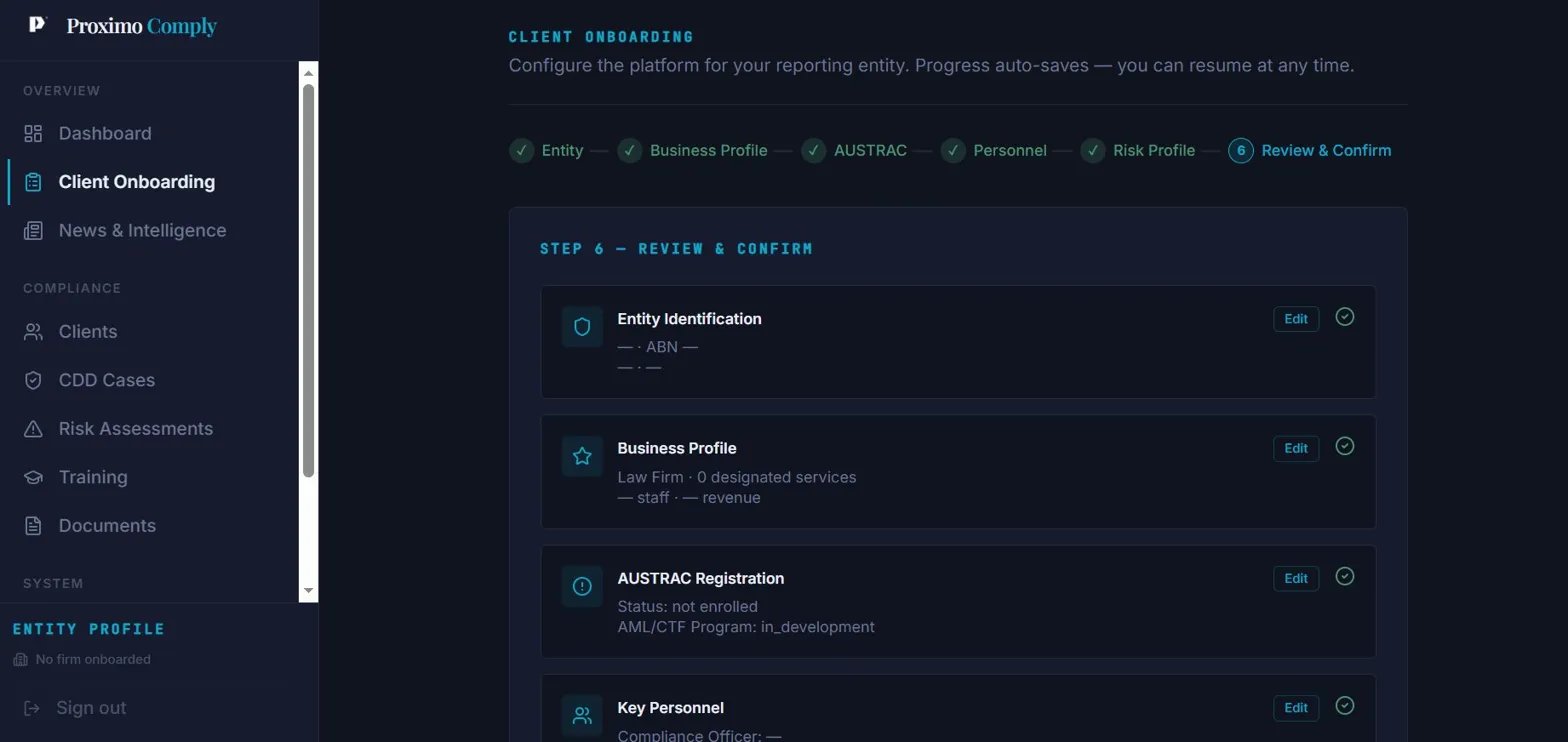
Yes — an AML/CTF programme is legally mandatory for every reporting entity. It is a documented, risk-based framework that describes how your firm identifies, manages, and mitigates money laundering and terrorism financing risks. It must cover: customer identification and verification, ongoing customer due diligence, transaction monitoring, a suspicious matter reporting procedure, staff training, and record keeping. AUSTRAC requires the programme to be tailored to your specific entity type and the nature of your designated services. Proximo Comply generates a draft programme in hours, aligned to AUSTRAC's published starter programme templates.
What is the maximum penalty for non-compliance?
The maximum civil penalty under the AML/CTF Act is A$33 million per breach for a body corporate. Individual practitioners face personal liability. AUSTRAC has demonstrated willingness to act: Westpac was penalised A$1.3 billion and Commonwealth Bank A$700 million for AML/CTF breaches. For smaller firms, even minor non-compliance can result in enforceable undertakings, public censure, and remediation costs that dwarf the cost of compliance software.
What is customer due diligence (CDD) and what does it require?
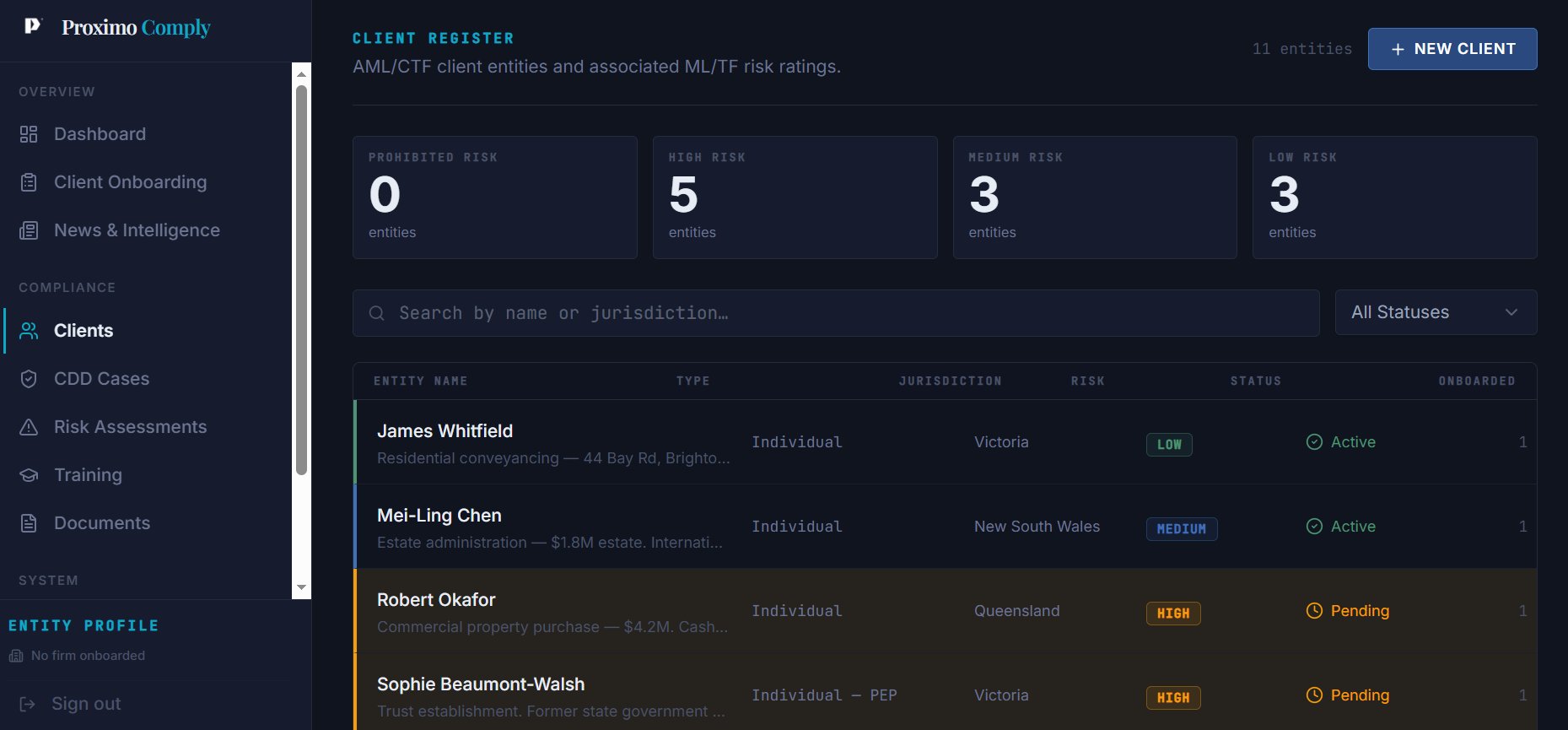
Customer due diligence (CDD) is the process of identifying and verifying the identity of clients and understanding the nature of the business relationship. AUSTRAC's reformed regime requires a risk-based approach: low-risk clients receive standard CDD, while high-risk clients — including politically exposed persons (PEPs), clients from high-risk jurisdictions, complex trust or corporate structures, and cash-intensive transactions — require enhanced due diligence (EDD). CDD must be conducted before providing a designated service, and records must be retained for 7 years. Proximo Comply provides a structured CDD workflow and client risk register pre-configured for your sector.
What is a Suspicious Matter Report (SMR) and when must I lodge one?
A Suspicious Matter Report (SMR) must be lodged with AUSTRAC when you form a suspicion that a client or transaction may be related to money laundering, terrorism financing, tax evasion, or another serious offence — even if no transaction has occurred. The obligation arises from suspicion, not proof. SMRs must generally be submitted within 24 hours (for terrorism-related matters) or 3 business days of forming the suspicion. Tipping off a client that an SMR has been filed is a criminal offence. Proximo Comply provides a structured SMR decision workflow with documentation templates.
Is Proximo Comply available now, before 1 July 2026?
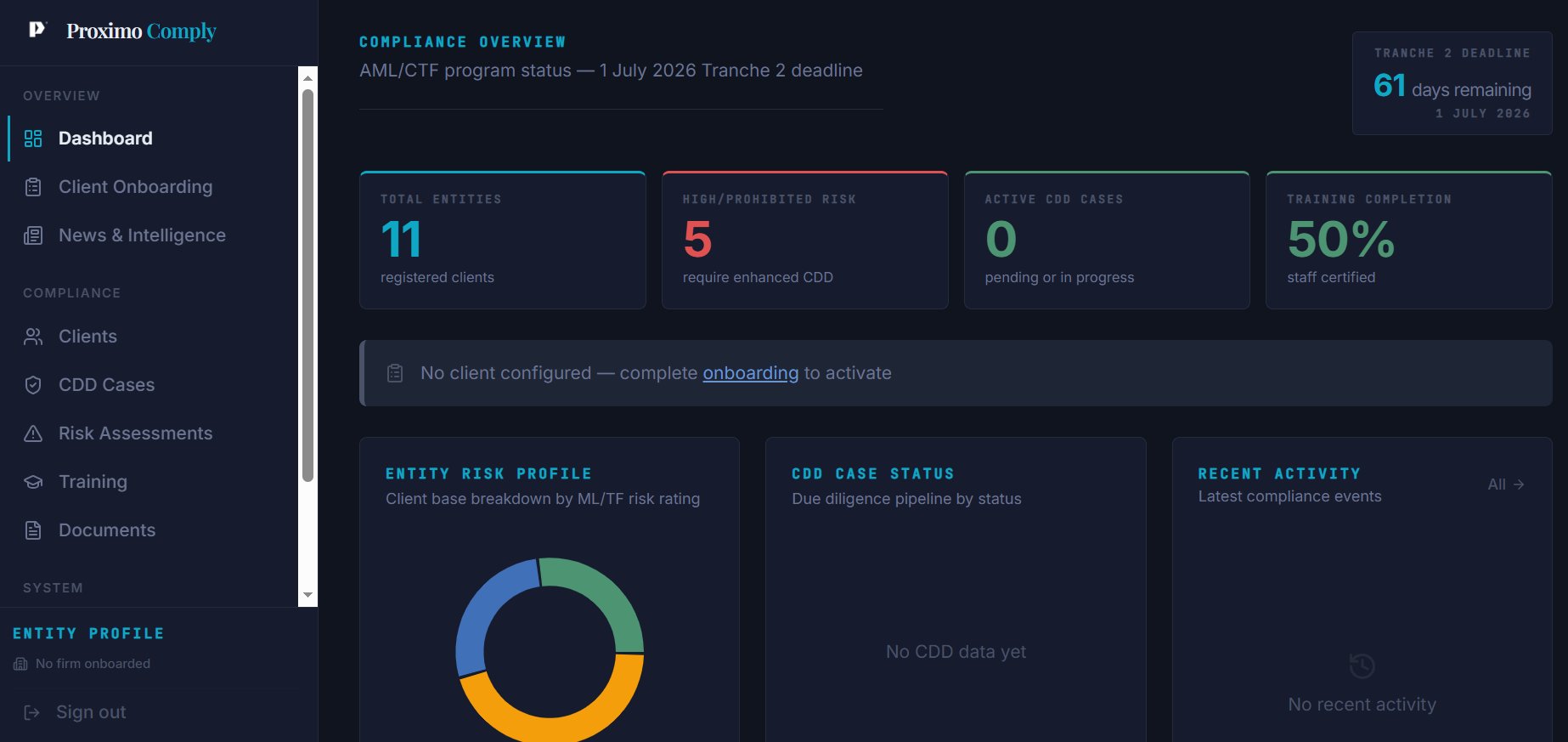
Yes. Proximo Comply is live and operational today. Australian professional services firms are onboarding now. The platform is fully functional across all modules: AML/CTF Programme Builder, Client Register with ML/TF risk ratings, Customer Due Diligence workflows, Compliance Calendar, Suspicious Matter Reporting, AI-generated document suite, and live AUSTRAC intelligence feed. With 61 days to the deadline, starting now gives your firm time to enrol with AUSTRAC, develop and review your programme, onboard existing clients, and train staff.
What documents does Proximo Comply generate for my firm?
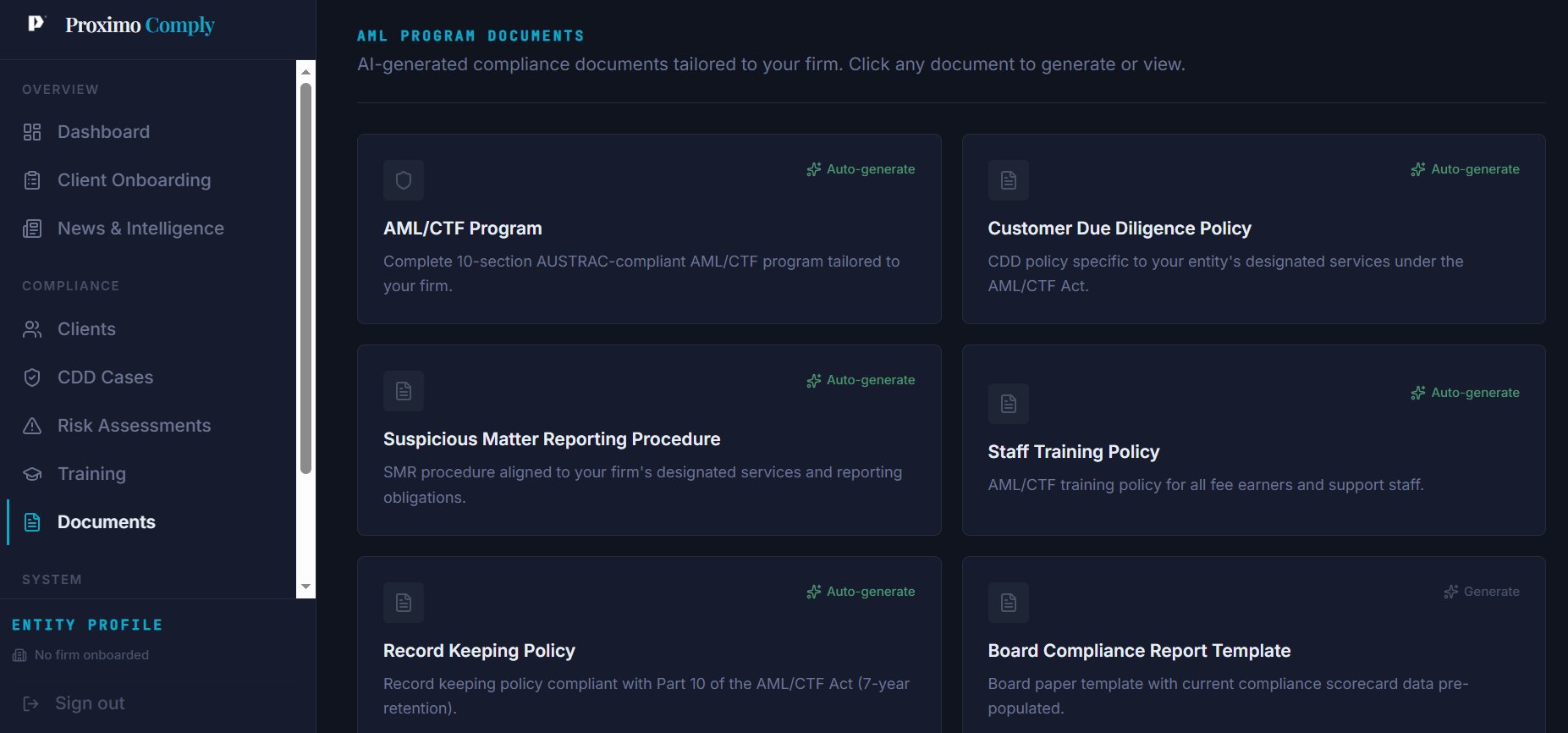
Proximo Comply auto-generates six core compliance documents, each tailored to your entity type and designated services: (1) AML/CTF Programme — a complete 10-section AUSTRAC-compliant programme; (2) Customer Due Diligence Policy; (3) Suspicious Matter Reporting Procedure; (4) Staff Training Policy; (5) Record Keeping Policy — compliant with Part 10 of the AML/CTF Act (7-year retention requirement); and (6) Board Compliance Report Template with pre-populated compliance scorecard data. All documents are generated in minutes, not weeks.